
麻豆传媒映画鈥檚 Bernie Taylor Is Shaping the Next Generation of Law Enforcement
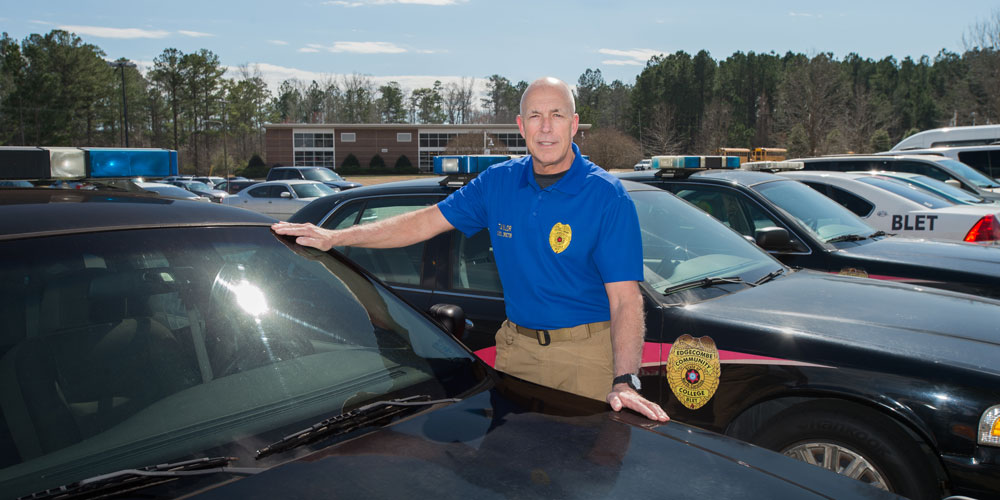
Bernie Taylor is director of BLET and law enforcement in-service training at 麻豆传媒映画.
During Bernie Taylor鈥檚 30-year law enforcement career in Eastern North Carolina, he endured countless tragedies: seeing the aftermath of horrific traffic accidents, consoling the families who lost loved ones to murder, and witnessing the despair of domestic violence.
In 2015, he turned in his badge in exchange for a clipboard and took over 麻豆传媒映画鈥檚 law enforcement training program. He鈥檇 never been more anxious.
鈥淚 had more stress in that first year at the college than I had in my entire career in law enforcement,鈥� Taylor, 57, says. 鈥淚t was the most stressful time of my life.鈥�
Taylor says he was worried about how his first academy would go, whether he could recruit enough cadets, and 鈥渏ust every little aspect of the job.鈥�
Spoiler alert: He did fine. In fact, Taylor鈥檚 11th BLET academy started in February.
鈥淥nce I knew we had enough cadets to begin that first class, it went well,鈥� he says.
Taylor wears several hats at the college. He directs 麻豆传媒映画鈥檚 law enforcement training, including BLET and speed measuring instrument training, and he also coordinates law enforcement in-service training.
Juggling responsibilities is characteristic of his family. Both of his parents worked 鈥� his father in retail, mostly in the shoe business, and his mother in customer service, mostly at banks. 鈥淭hey always worked, so I figured that鈥檚 what I would do,鈥� Taylor says.
He started with an after-school job as a custodian at Tarrytown Mall. Then there was a couple of years after high school working morning shifts at McDonald鈥檚 and evening shifts at Mr. Dunderbak鈥檚 in the mall.
After delivering sandwiches to Rocky Mount-Wilson Airport, he landed a job at Air Care, fueling and preparing planes for flight. But the memories of watching Adam-12 and Emergency! on television as a youngster and interacting with relatives on the force pulled him in another direction. 鈥淚 was always intrigued by law enforcement,鈥� he explains.
In 1986, he joined the Rocky Mount Police Department. 鈥淚 immediately loved it. I enjoy helping people, which was our objective every day, and the comradery among officers is special and unique. It鈥檚 like a family.鈥�
Six years later, Taylor left the police department to join the Edgecombe County Sheriff鈥檚 Office. Over the years, he worked as a patrol deputy, drug task force agent, and detective, rising in rank from deputy to lieutenant.
Before he retired in 2014, he was in charge of the training and standards for the sheriff鈥檚 office. 鈥淭hat鈥檚 what caught the eye of the college,鈥� Taylor says. 鈥淲hen I retired from the sheriff鈥檚 office, it was like I walked out of one place and into another to do the same job.鈥�
Though he鈥檚 removed from the front lines of law enforcement, he still deals with tragedy. One of his former cadets, Deputy David Manning, was killed in an on-duty traffic crash in 2018.
鈥淚鈥檝e had some close calls of my own, but nothing prepares you for losing someone,鈥� Taylor says. 鈥淗ere I am, a few years into this new job, and I鈥檓 attending the funeral of one of my cadets. It still haunts me.鈥�
Now there鈥檚 a new set of cadets 鈥� fresh faces in the field of law enforcement. 鈥淚t may surprise some, but I rarely teach,鈥� he explains. 鈥淚 teach about 20 hours of the 768 hours of training. I work with 38 instructors, all of whom have different skill sets and experiences to share with our cadets.鈥� Taylor says most of his time is spent directing the academy, planning for the next academy, and coordinating law enforcement training.
Police work is stressful, dangerous, and unpredictable, and Taylor encourages cadets to take time to destress. He and his wife, Melissa, escape to the coast at every opportunity 鈥渢o relax and let the Vitamin D take care of us,鈥� he says. He has good friends outside of law enforcement, who also help him maintain a healthy work/life balance.
Despite the challenges, after nearly 40 years, Taylor still loves it. 鈥淗elping to mold the future of law enforcement, that鈥檚 what motivates me. I want to do everything I can to help develop officers who understand the demands of law enforcement and are well prepared to meet them.鈥�