
麻豆传媒映画 EMS Responds to COVID
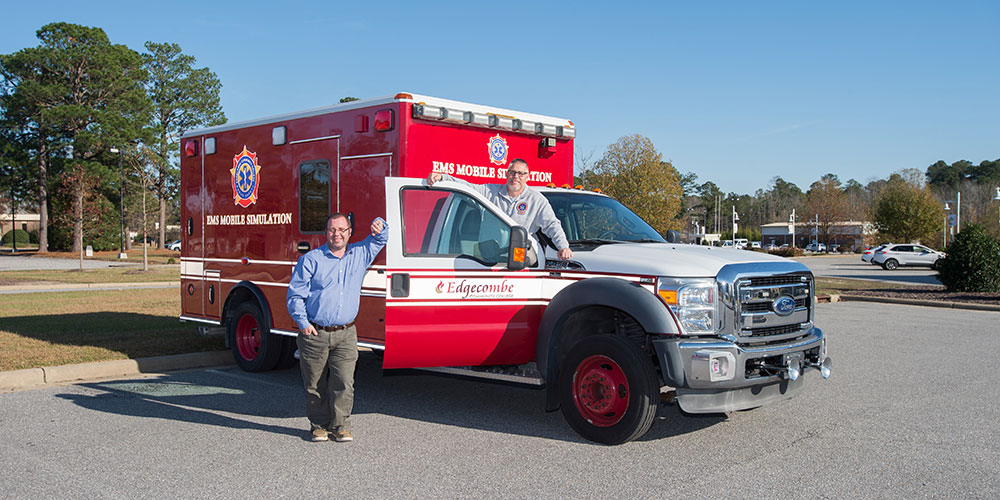
麻豆传媒映画 Emergency Medical Services personnel Adam Culbertson (left) and John Wilson are shown with the College鈥檚 new ambulance for EMT and paramedic training. 鈥淲e have the best of both worlds in simulation training,鈥� says Wilson, coordinator of EMS and fire services training at 麻豆传媒映画. 鈥淲e offer first-rate instruction in a brick and mortar facility with the Lamm Building, and now we have advanced training on wheels.鈥�
The shift to remote learning due to the coronavirus pandemic has profoundly impacted teaching and learning nationwide. Prior to the pandemic, the shift had already begun at 麻豆传媒映画, which has been adding online programs and classes in recent years.
This year, hybrid course delivery that combines online study with hands-on learning has emerged as an effective teaching strategy, especially in healthcare programs. Nowhere is this more evident than in Emergency Medical Services.
鈥淓MS courses in general have been heading down the hybrid track,鈥� says John Wilson, coordinator of EMS and fire services training at the College. 鈥淲hat COVID-19 did was speed up that timeline.鈥�
Wilson, a paramedic for the past 26 years, says 麻豆传媒映画 offers flexible options to complete EMT and paramedic coursework, including online and in-person evening classes.
Adam Culbertson, a paramedic and EMS specialist at the College, says that in some ways, the pandemic has pressed 麻豆传媒映画 to move forward.
鈥淲e lagged a little behind in technology in setting up classes,鈥� he says. 鈥淏ut now we are creating virtual sessions. So, in that sense, we have strengthened our program and attracted new students over the past six months.鈥�
The College鈥檚 EMS program serves agencies across North Carolina. Annually, 麻豆传媒映画 trains about 45 EMT, AEMT, and paramedic students. An additional 150 students complete various other courses offered through the EMS program.
Social distancing and mask requirements have created new protocols for these students. A temperature check is mandatory before faculty and students can enter a campus facility to attend hands-on labs.
EMS labs typically involve lots of close contact. Because classes are repeated multiple times during the week, the number of students is usually small enough to accommodate social distancing, Culbertson says.
麻豆传媒映画 EMS and paramedic students are taught by a team of about 35 part-time instructors, all of whom work in the field and share lessons learned on the front lines.
Instructor David High says masks have weakened communication between EMTs and patients. 鈥淚t鈥檚 difficult to hear some individuals while they鈥檙e masked, and it鈥檚 impossible to analyze facial expressions,鈥� he says.
鈥淲earing a mask takes a lot of our personality out of the equation,鈥� High continues. 鈥淲e鈥檙e going into someone鈥檚 home at possibly the worst moment of his or her life, and we need to be able to offer some type of comfort, whether it鈥檚 to provide medical treatment or to ease their tension with a smile. I try to connect with my patients, but with a mask, it鈥檚 a challenge.鈥�
Emergency calls dropped at the onset of the pandemic, but have since surged. 鈥淔rom March through April, our call volume dropped through the floor. But now, the call volume has gone up, higher than it鈥檚 ever been,鈥� Wilson explains. 鈥淎nd I think we are now in a world where we are going to wear a mask on every call. That will never go away.鈥�
Culbertson says that most paramedics and EMTs presume that patients are COVID-positive until proven otherwise. Now, just one emergency worker enters a home wearing a gown and mask to assess a patient, limiting exposure.
For EMTs and paramedics, disinfecting themselves and ambulances has always been a priority. Today, ambulance crews are even more diligent in ensuring that everything is sanitized.
鈥淲e disinfect our trucks on a regular basis,鈥� Culbertson says. 鈥淏ut if we transport a potential or known COVID patient, the ambulance will go out of service for a couple of hours so we can spray down the entire inside. Our personnel also bring extra uniforms and shower before answering more calls.鈥�
When an ambulance is out of service for COVID cleaning, back-up trucks and mutual aid ambulances from other districts and counties will cover that area until the original truck is back in service.
“This is new for everybody,鈥� Culbertson adds. 鈥淲e鈥檙e going to continue to learn a lot of lessons. EMS is a stressful environment, and it takes a toll.
鈥淏ut the biggest thing is that we don鈥檛 consider ourselves heroes. When we signed up to work in EMS, we knew this day might come.鈥�